I found a CEA-608 encoding anomaly on the Little Shop of Horrors VHS (catalog no. 11702). At some point during the showing there is a subtitle encoded as “CANAPé” instead of “CANAPÉ” as following the style would call for.
The usual style for captions is all-uppercase letters for dialog, normal case letters for whispering. A later extension (CEA-608-B) added extended italic tags… but I’ve never seen them used in a movie just yet.
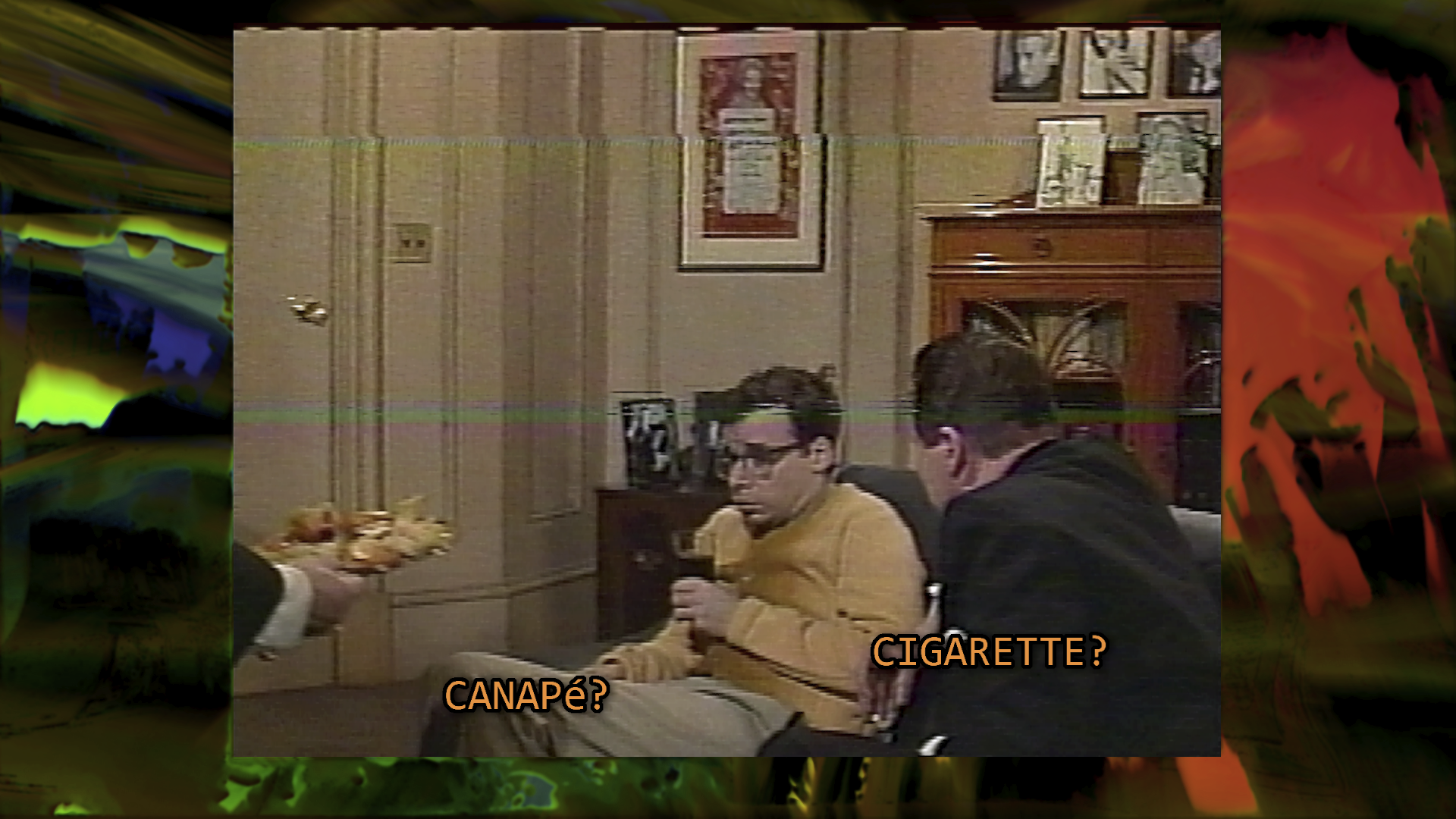
Why does this anomaly exist: the base CEA-608 character set only includes a lowercase “é” encoded as part of the basic set (single byte 0x5C). Uppercase “É” was only added later and is part of the extended character set 1.
So either this was encoded before the CEA-608-B extension or more likely it was just encoded on legacy hardware/through a legacy working process. The uppercase “É” would be encoded by three bytes: 0x45 0x12 0x21, which will print basic character set “E” followed by a control code which - if supported - will step one character back and overwrite “E” with “É”.
The CEA-608 standard says “transmit the standard character that most closely resembles the extended character, for receivers that can’t decode it”… so there is a way to encode this in a better way - if the closed captions encoding system used would allow to enter such a sequence.
This would be the CEA-608 sequence for the subtitle in question: 0x4341 0x4E41 0x505C 0x1221 (grouped by two bytes). What it encodes: “CANAPé” followed by “extended set 1 character É” command which implicitly performs a backspace.
This would output “CANAPÉ” on later decoders and revert to “CANAPé” on earlier decoders without a violation of the spec in spirit (usually E is considered the fallback character for all E-accented character glyphs).