While working on the sky system, I had a thought about adding random space debris re-entering atmosphere. It would be a really telling and interesting piece of narrative that illustrates the state of the world - in the setting of Synesthesia, in year 2994, most of the space operations have been abandoned and overall there is no organized effort to monitor space debris anymore.
There are still millions of objects in orbit - many of these are private satellites, spacecraft and other assorted hardware. There are a few large objects (space stations and old spacecraft) which will eventually decay and re-enter atmosphere. All sorts of debris routinely enters the Earth atmosphere.
A large proportion of this debris is the result of the progressing Kessler syndrome, making any space travel dangerous and forcing people to abandon many of the space-based operations.
The player would be able to see these happen randomly. Many of them may be too small to notice unless they get lucky, however there may be a really big event once in a while.
The re-entry effect is implemented as a particle system combined with a fairly simple thermal simulation. The debris objects are spawned at the height of about 120-140 km and are given a random, statistically distributed direction & entry angle.
The objects continue to fly free and a simple break-up model is used to calculate when the object finally burns up. It is a fairly simplistic model, it is possible that I might improve it in the future.
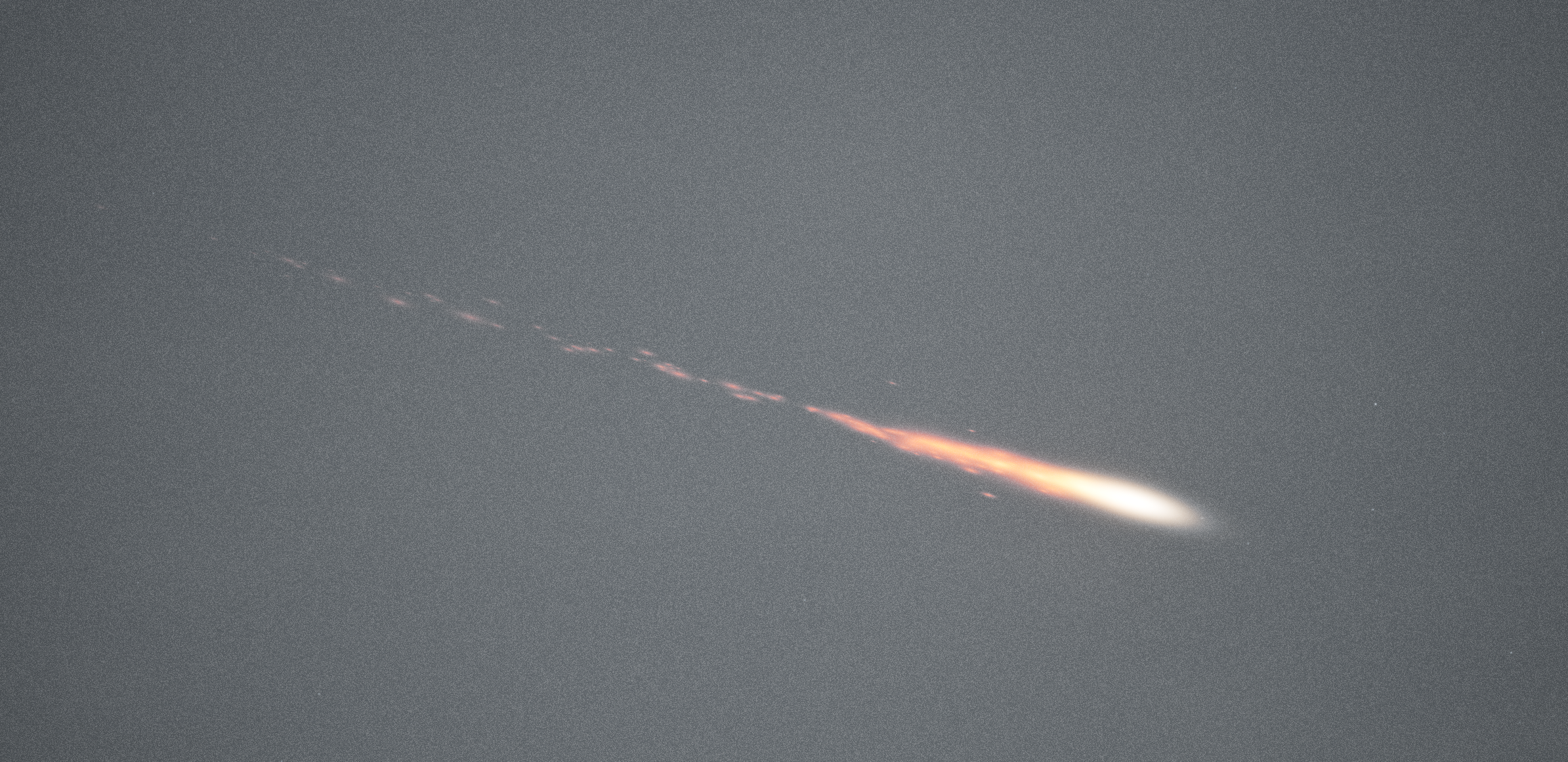
One definite improvement I want to make is using better sprites - it would make the re-entry trails much more distinct, vivid, and less blurry. It would also emphasize multiple objects traveling in the re-entry path as the main object continues to shed debris.
The video below shows a better look at the hot entry and break up of the object. The re-entry event, if detected by players information systems, will also be recorded in the minor event log.
The re-entry events are defined by the following parameters:
- Object mass - this defines how much debris is generated and how long can the object withstand high temperature.
- Burn rate - this defines how fast temperature burns up the mass of the object or causes debris shedding events. The effective burn rate is proportional to this value and the current temperature.
- Entry vector - the simulation has a simple exponential model of atmosphere, so shallow and steep re-entries look distinctly different.
A combination of these parameters can be used to set up a re-entry that looks most artistically appealing. The sky system creates random procedural re-entry events. For special scripted events, the same particle system can be created manually and multiple systems can be combined to create an appearance of a very large object breaking up.
Here is a close-up picture of the re-entry event. For prototyping, I’ve been using a simple spherical sprite, which makes the entire trail look quite blurry. The quality should improve considerably when the sprite will be more drop-shaped, with a large glowing core and a small trail following it.
In addition to immersion, I want to include the re-entry effects in at least two elements of the narrative itself:
- A side quest, during which the player can force a spacecraft in orbit to burn its engines for re-entry. While not having effect on the main quest, it would be narratively connected to the plot events.
- A random event, during which an object re-enters over the EDZ-01 and visibly reaches surface.